
Overview
The fight against food waste apparently has no expiration date. With rising food prices, the fight against food waste has become more urgent than ever before.
In today’s world, where issues like climate change and resource depletion loom large, the concept of sustainable consumption and production has gained significant traction. At the heart of this discussion lies the issue of food waste and its implications for both the environment and society. In this workshop, we will explore the root causes of food waste and examine the potential of circular economy principles to mitigate this pressing issue.
Overview
Learning Objectives
- Define Circular Economy and its principles.
- Understand the influence of individual lifestyle choices on social, economic, and environmental development.
- Recognize the roles, rights, and duties of different actors in production and consumption.
- Grasp the dilemmas and trade-offs associated with achieving sustainable food consumption and production, as well as the system changes necessary to address them.
Understanding the Food Industry and its Waste
The food industry is a complex web of producers, distributors, retailers, and consumers, all interconnected in a system that often prioritises profit over sustainability. According to the Food and Agriculture Organization (FAO), approximately one-third of all food produced globally is lost or wasted each year, amounting to roughly 1.3 billion tons. This waste occurs at various stages of the supply chain, from production and processing to distribution and consumption.
The Concept of Circular Economy
Circular economy is a regenerative approach to economic development that aims to minimise waste and maximise resource efficiency. Unlike the traditional linear model of “take-make-dispose,” circular economy seeks to close the loop by designing out waste and keeping products and materials in use for as long as possible. Key principles of circular economy include:
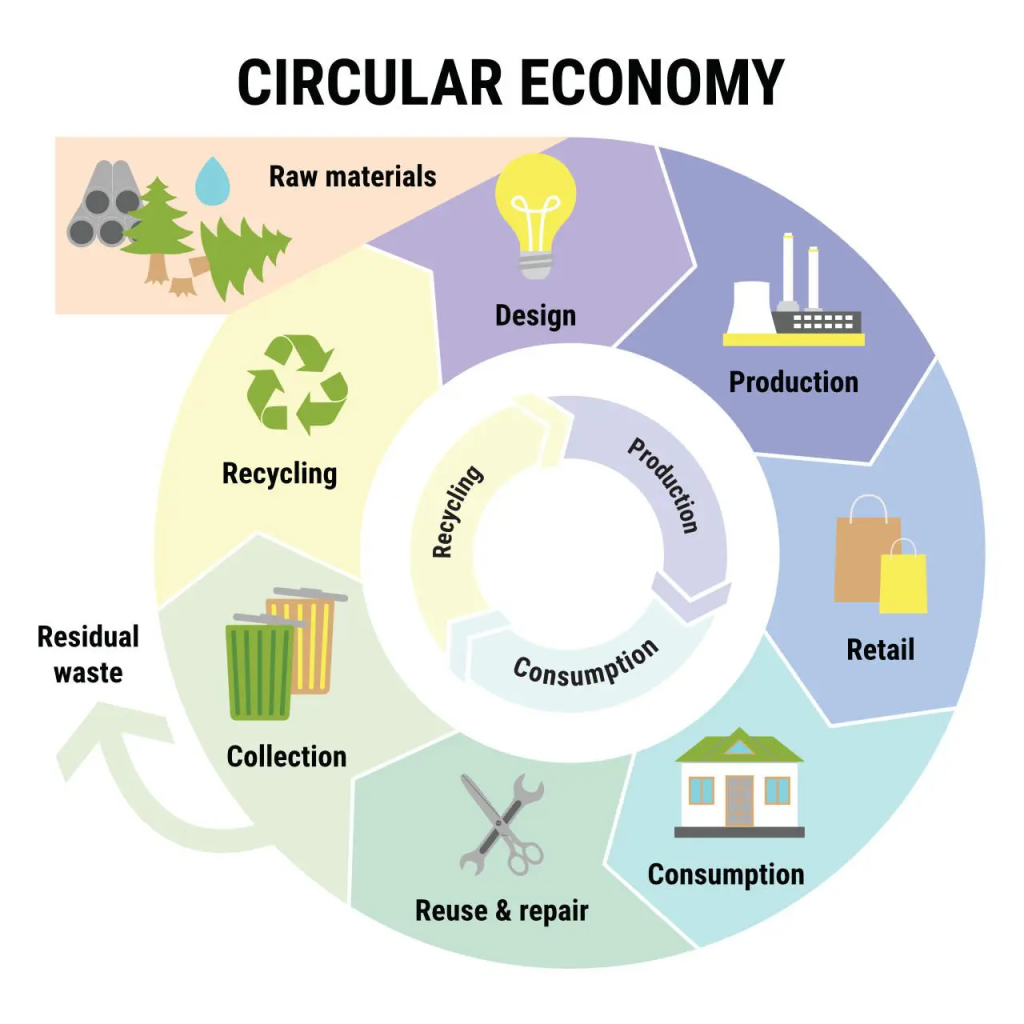
Source: https://www.certificationeurope.com
The key features of a Circular Economy are:
- Designing products for longevity and recyclability
- Emphasising reuse, repair, and remanufacturing
- Shifting from ownership to access-based models (e.g., sharing and leasing)
- Promoting renewable energy sources and sustainable resource management
Addressing Food Waste through Circular Economy
Applying circular economy principles to the food industry offers a promising solution to the pervasive problem of food waste. By adopting strategies such as:
- Implementing sustainable agricultural practices to minimise crop losses
- Reducing overproduction and surplus food through better planning and forecasting
- Establishing networks for surplus food redistribution to redirect edible food to those in need
- Investing in innovative technologies for food processing and preservation
- Designing packaging for recyclability and promoting compostable alternatives
Educational Initiatives for Sustainable Consumption
Education plays a crucial role in fostering a culture of sustainability and promoting behaviour change among consumers. By integrating concepts of sustainable consumption and circular economy into school curricula and educational programs, we can empower young learners to make informed choices and become advocates for change in their communities.
Implementing Circular Economy in Communities
Community engagement is essential for the successful implementation of circular economy practices. By organising workshops, seminars, and community events, we can raise awareness about the importance of reducing food waste and encourage active participation in sustainable initiatives. Collaborating with local businesses, government agencies, and nonprofit organisations can further amplify our impact and drive meaningful change at the grassroots level.
Case Studies of Successful Circular Economy Models
Examining real-world examples of circular economy in action provides valuable insights into the feasibility and effectiveness of sustainable practices. Case studies from diverse sectors, including food, fashion, and technology, demonstrate the tangible benefits of adopting circular economy principles, such as cost savings, resource conservation, and enhanced resilience to external shocks.
Food production, how the industry works and how so much of the food produced gets wasted. Learn about circular economy to discuss possible alternative models to the buy-use-throw away while supporting participants rethink their community.
Duration
Approximately 2 hours
Instructions to Organise the Workshop
TASK 1
Introduction to Circular Economy (20 minutes)
PRESENTATION PROVIDED
Presentation: Deliver a short presentation covering the key principles of the Circular Economy (reduce, reuse, recycle, rethink) and explain how these principles can be applied to reduce food waste. Use visuals and examples to make it engaging. Share a few compelling statistics on food waste, emphasising its environmental consequences. For example, the amount of food wasted globally and locally the carbon footprint of food waste.
Discussion: Ask participants to discuss and share their own experiences or observations related to food waste. Encourage them to consider what factors contribute to food waste in their households or communities.
TASK 2
Reflection on Personal Consumption and Production Patterns (20 min + preparation)
This task is to help you realise how your regular behaviours are related to food waste (consumption and production). Understanding this will help you implement changes in your lifestyle and become more aware, thus you will be more able to give examples as for how to live more sustainably to your youth learners.
For this task, please use the reflection journal we asked you to create as a preparation.
Step by step instructions:
- For one week, use the journal to write down everything you consume and produce. (This can not only include food, but also clothing, household items, transportation, and other goods and services).
- For each item, record the following information:
- The item itself
- The source (e.g. where you bought it, who you received it from)
- Any thoughts or feelings you had about the consumption or production of the item.
- After one week, review your journal and reflect on your consumption and production patterns. Consider the following questions:
- What were your main sources of consumption and production?
- How did your consumption and production patterns change throughout the week?
- Were there any items that you consumed or produced that you felt guilty or concerned about?
- Were there any items that you consumed or produced that you felt good about?
- Are there any changes that you would like to make to your consumption and production patterns in the future?
- Are there any challenges that you face in trying to make these changes?
- Share your reflections in a group discussion and brainstorm ways to reduce the negative impact of your consumption and production patterns
Task 3
Circular Business Models (25 min)
Showcase examples of circular economy practices in the business world.
Case Studies: Present examples of companies that have successfully adopted circular business models. Discuss how these businesses have reduced waste and resource consumption while increasing profitability. For example:
Urban Agriculture and Vertical Farming.
Composting Services example
Food Recovery and Redistribution examples
Food Preservation and Fermentation Businesses example
Educational Initiatives:
TASK 4
There are stages before food consumption (20 min)
This activity aims to point out a holistic approach to food products, since the majority of the general population is connected to food only through this final stage.
Participants working in groups are given photos from various food products (milk, eggs, bread, oranges, etc.). The facilitator asks the groups to think about the stages of each product, from production to consumption, and write them down as a linear process. In a plenary session, every group presents its work and the following discussion results in the five stages of food products (agricultural production; post-harvest handling and storage; processing; distribution; consumption). Finally, participants are asked to consider the potential FLW at each stage.
WRAP UP ACTIVITY
Ask participants to make a personal commitment to implement a circular economy practice in their daily lives. It could be something as simple as composting organic waste.