
Framework
Shape your ideas
Sustainability strategy and methodology
Community sustainability is related with the issues of how well the project and its results are rooted in the community. The key for have the community (in the wider sense) be responsible for the use and continuous promotion of the results is to share ownership of the products and the other results with them. If the community does not feel ownership of the project or its results, even with a well-thought-out strategy, the products and results will probably be forgotten.
In other words, community sustainability is related with stakeholder engagement and support that the partners can get from their local partners and key actors. It also deals with the way the products is made available and accessibly to the local community, once the partners have made them available and visible for all to use. This part is strictly connected with dissemination and the work the partners have been doing along the project activities.
Sustainability strategy and methodology
The present plan will offer guidance based on the following principles
- Future – the plan will offer suggestions on action and tasks the partners can implement within the project duration to ensure results and products usage in the long period. This requires a trained staff able to maintain the products as they are or to innovate them, as the needs of the target group will change.
- Participation—Sustainability is a shared task. Partners have to involve others actively in the process in order to spare resources or to collect new ones. This requires a lot of education and trust to engage stakeholders and build their capacity to identify issues, include local values, and communicate their experiences.
- Resources—This is related with (HR, financial, technical, material, immaterial…) resources consumption and improvement in its use. This requires ways to identify and manage the resources and seeking new knowledge and information about it.
- Context— It refers to specific situation of the partner. The present plan must be aligned with the context and, more importantly, it must fit the partner strategy. The goal is to ensure the partner’s resources are allocated and tasks planned appropriately – offering short/mid and along terms details.
Sustainability or “the Life after the end of the project”.
One of the guiding principles in planning dissemination and impact of results is that the end of the funding period should not be the end of dissemination activities. The project period is often a phase of intensive work towards ambitious goals. It is wise to think of the time after the project period while still in the first phase. If dissemination can continue after the end of funding the project’s impact and sustainability can be increased. This is a difficult task for many partnerships. In spite of the problem of finding both the resources and the motivation for continuing dissemination activities the long view should eventually replace the much shorter term of the project’s funded period.
The main element that will ensure sustainability and long-term impact of the proposed action is the commitment and professional approach of the partners and their ability to work for and with the target group. The partners have the capacity and the skills to run the project, maintain the results for the future use and to involve stakeholders and target groups to reuse in the future.
The activities in the project will provide a learning by doing process that will guarantee their ability to reuse, update and reshape the materials and resources produced to adapt them to their audiences’ needs. This is one of the key elements in the project and within the spirit of the E+ program: the ability to apply learned skills to any other task, job or career the staff and participants will take in the future.
Main tasks in this phase
By working on the project and by using the project’s resources, the partners are expecting:
- Increased quality in the services offered to girls and young women in the community participating in the project. Considering that some partners have connections with several villages and communities, we will engage them during the project and we will motivate them to adopt our method for community inclusion.
- Increased skills and professionality of the partners’ staff, members and volunteers. They will be part of the training camps, acquire skills by cooperating with the EU and non-EU counterparts and will be able to replicate the methods in the future, with new beneficiaries. They will pass the knowledge to new members, also using the toolkit and training materials provided by the project
In addition, the partners will prepare a strategy for facilitating the sustainability and exploitation of project results:
- Creating a network to spread the results of the project and continue to sustain them after the project’s lifetime.
- Each partner in the consortium will contribute to promoting the project’s outcomes in their respective countries.
- Partners will continue to inform direct beneficiaries are involved in the project, and that project results are visible and transferred to them.
- All partners in the consortium should make their premises available for further capacity building activities with other educators and learners who want to follow the program, during group-based or individual activities.
- Mapping of end-users: Partners will map potential users, (youth, NGOs). Partner will carry out to ensure close cooperation. In each partner country at least 2 additional end-users will be reached.
- Materials freely available online. Resources guaranteed for the maintenance of results: i.e.) Know-how, human resources, facilities and material of the partners for the provision of the training modules/handbook/toolkit/knowledge hub
- It will be maintained (including all the outputs, results) at least 5 years after the project ends by the coordinator. Maintenance costs are low (webpage on existing server), partners will devote 5 working days/year after project end -voluntary
- Youth, youth workers, NGOs with new competences allow them to act as multiplicators of good practices. Youth will establish additional 2 joint projects, which are bankable and self-sustainable.
- Networking with other organizations identified to extend the project to other EU countries and achieve long-term impact on primary stakeholders throughout Europe, signing MoU
Non-tangible project results will proceed with a transfer to the partners’ activities during the project implementation to increase a likelihood to become a significant element of the activities in the partner organizations. We will also further promote the project at various local, national, and international meetings, conferences, workshops, trainings, educational activities, youth conferences and seminars, etc. Partners will include other organizations and youth outside partnership in project activities, which assures more efficient sustainability during project implementation and new synergies.
Sustainable project results may appear very different from project to project. They may range from at least using the results in the partner institutions up to integrating a curriculum developed by the project into mainstream provision. In many cases an excellent way of making a project last is to organise on a regular basis a Grundtvig in-service training course for staff of adult education institutions. Through such courses the project partnership can get valuable feedback on the project products and also find new channels and ways of exploitation. Participation in these courses is funded by the National Agencies of the Lifelong Learning Programme.
There can be no doubt that the funding programme expects quite a lot by assuming that a Partnership Project funded for two or three years should have a sustainable impact. Nor are there sufficient support and capacity building mechanisms at European or national levels to help Partnership Projects to live up to these high expectations. On the other hand, it is legitimate to ask for a certain degree of impact beyond the direct beneficiaries if public money has been spent on a project.
Literature suggests a large number of factors affect project sustainability. Factors that increase the likelihood of sustaining a project relate to:
- project design and implementation.
- the host organization; and
- the broader community.
The Matrix below identifies some elements and suggestions that can be used to plan sustainabity within the project planning, in order to build the potential for sustainability into their projects.
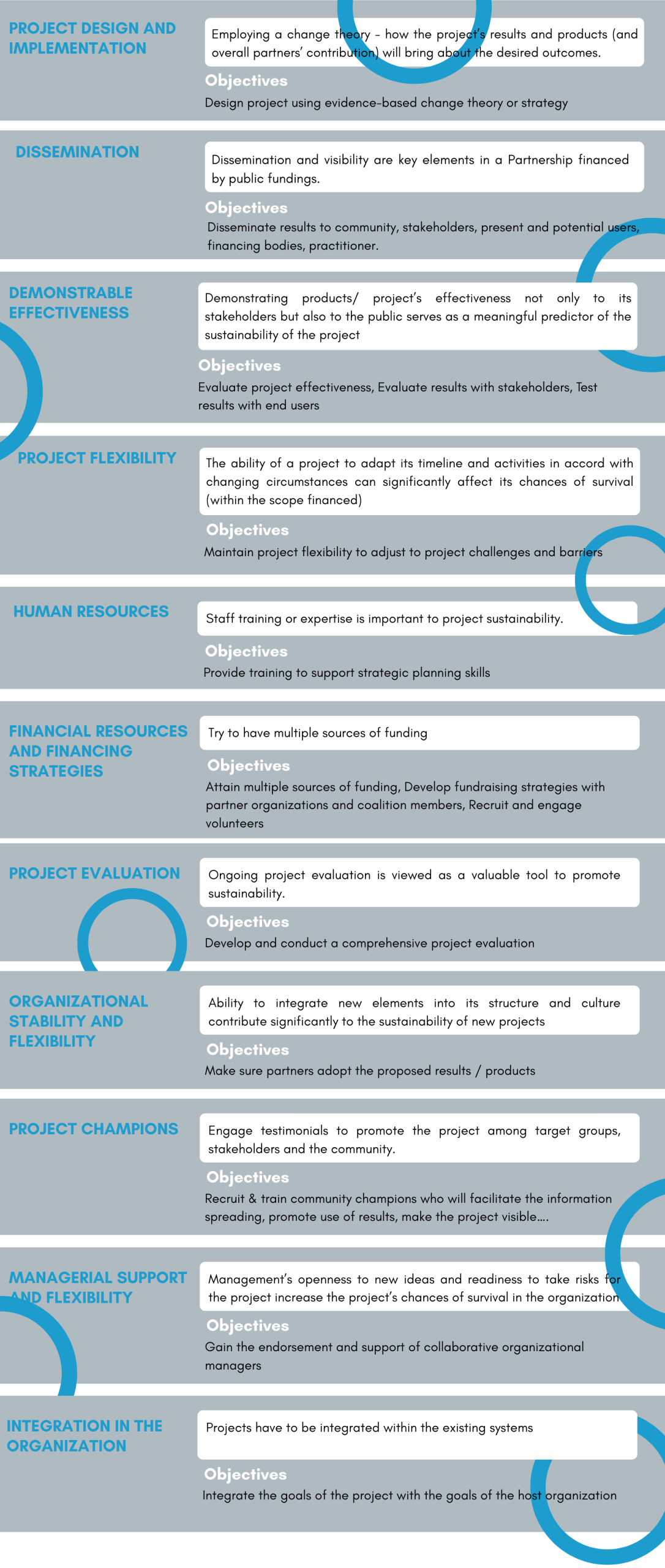
Partners should seek to incorporate these sustainability objectives into their local plans during the development phase and continue to address them during the implementation phase.
A possible minimum level of sustainability each Partnership should be able to reach:
There is still a contact person available for at least the whole project, or, preferably in each partner institution
The project results are integrated and systematically used in the partner institutions and disseminated in their local (national) environments
The main project results continue to be distributed in their local (national) environments by all partners and can be easily obtained on request
The project website is maintained and fully operational for three years after the end of the funding period. Through the website potential users can access the project results and ask for support from the project partnership when using them
About stakeholders
Stakeholder mapping involves identifying, analysing and prioritising the people and organisations with a stake in your project features and performance. Initially this will assist the partner to determine project requirements and ultimately it will help you to manage and communicate with your stakeholders effectively. Most of the stakeholders you are mentioning in the sustainability plan are the one you should have analysed and engaged when planning for dissemination and visibility of the project in your area.
Informing and involving them in the project’s activities will contribute to making the projects visible at a local and international level. They will be invited at the local events, at the seminars and pilot program in the partners countries. If possible, they will be invited to participate in the final event.Planning for sustainable results
The main element that will ensure sustainability and long-term impact of the proposed action is the fact that the partners are already working with and for the target groups of the project. Thanks to the different capacity building camps and the cooperation, the present and future members in the partners’ organizations will be able to improve, update and reshape the materials and resources produced to adapt them to their future needs. This is one of the key elements in the project and within the spirit of the E+ program: the ability to apply learned skills to any other task, job or career the staff and participants will take in the future.