Framework
Shape your ideas
Internal communication
Internal communication refers to the exchange of information and messages between partners of the project. Effective communication is crucial for project managers to keep teams aligned, stakeholders informed, and projects on track. Key skills include active listening, clear and concise writing, verbal communication, nonverbal cues, empathy, and conflict resolution.
It includes all forms of communication such as emails, meetings, memos, intranet platforms, and informal conversations. The purpose of internal communication is to ensure that everyone within the consortium is informed, connected, and working towards the common goal. A lack of communication leads to stress and misunderstanding among employees, as well as a lack of teamwork
Considering the fact that everyone is unique and prefers a particular mode of communication not only improves the distribution of information, but it also allows us to recognize people as individuals rather than numbers.
Along the project duration, partners usually stay in contact using emails and virtual meetings. The STEERING COMMITTEE will meet several times face to face to plan and to monitor the process and provide corrections to the planned activities to meet participants requests and needs.
Cross-cultural competency and inclusivity are increasingly important skills too. In a globalized work environment, the ability to navigate cultural differences and foster an inclusive atmosphere is vital, especially in transnational partnerships.
Project Managers must be sensitive to diverse perspectives, promote equity, and ensure that all team members feel valued and heard.
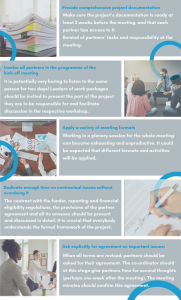
At the kick off meeting, it will decide if the partners will hold regular online meetings, how many and with what modality. Important decisions will be taken at the face-to-face meetings, so ensure everyone is clear and understand their tasks and we avoid misunderstandings, at each meeting.
The coordinator will set up a centralised online document depository (google drive or similar) to share documents and results. They will use ICT tools (emails, phone calls, virtual rooms, IMs and others) to allow partners to keep in contact regularly. At the kick off meeting a plan for information sharing has to be presented and made clear to all.
Main tasks
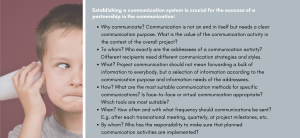
An internal communication plan with answers to these questions helps to keep track. It should be discussed and agreed at the kick-off meeting and defined with the local members for maximum impact.
One frequent phenomenon seen in many partnership projects is that too much and insufficiently filtered and prepared information is distributed. Such an overkill of information may arise from the good intention to spread knowledge liberally and be transparent. Yet it can endanger the project’s success, as it tends to de-motivate project actors.
The kick-off meeting
The importance of the kick-off meeting for the further development of the project cannot be over-rated. It is of vital importance to all that follows in a project.

Consequently, it should be planned with extreme care.